Evolution of Technology Timeline: From Stone Tools to Artificial Intelligence
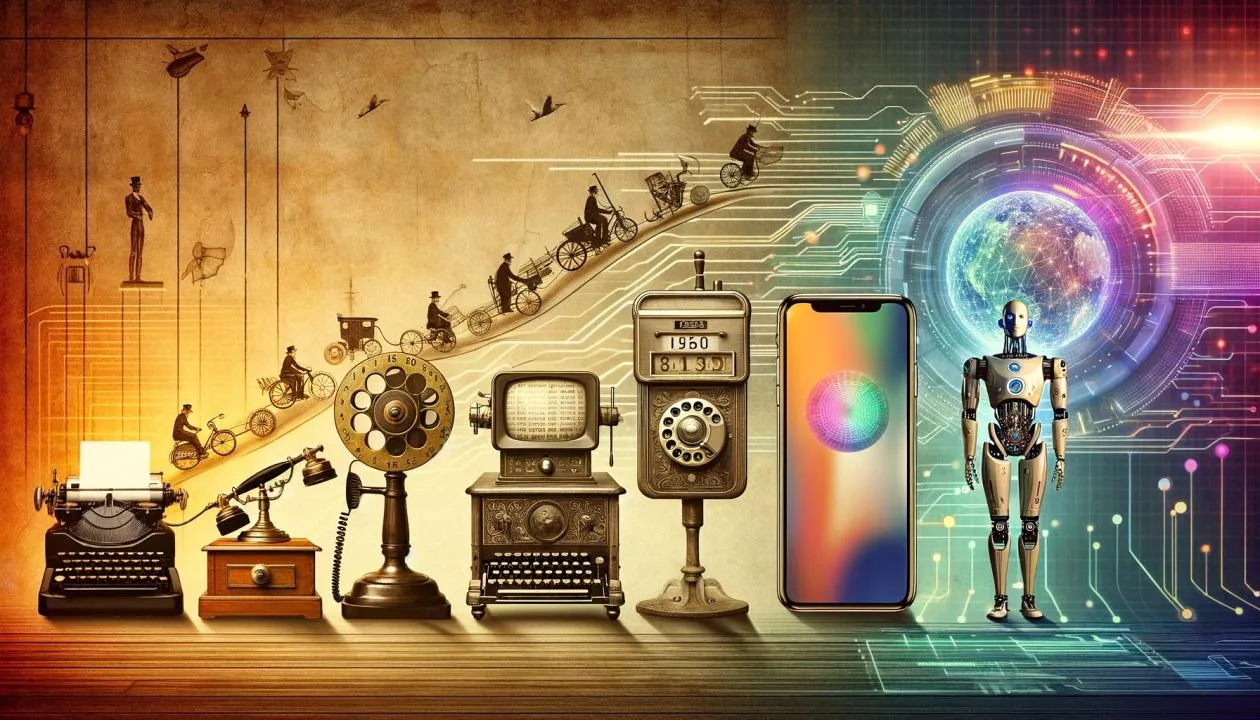
The evolution of technology timeline tells the story of how human inventions transformed life, from early stone tools and agriculture to electricity, computers, the internet and artificial intelligence.
For millions of years, humans and their ancestors have used tools to solve problems, shape environments and improve their ability to survive. Over time, new inventions made transportation faster, communication easier, manufacturing more productive and information more accessible.
Today, smartphones, computers and intelligent machines continue a history of innovation that began long before the digital age.
This visual technology timeline explores major discoveries, influential inventors and important historical milestones that changed the world.
Radio, aviation and electronic television research
Transformed communication and transportation
1940s
Early general-purpose electronic computers
Introduced large-scale electronic computation
1947
Point-contact transistor
Foundation of modern semiconductor electronics
1958–1959
Integrated circuit developments
Enabled smaller and more complex electronics
1969
ARPANET begins operating
Important milestone in computer networking
1971
Intel 4004 microprocessor
Early commercial single-chip CPU
1980s
Personal computers expand
Computing reaches more homes and workplaces
1989
World Wide Web proposed at CERN
Major development in online information sharing
1993
CERN releases Web software publicly
Helps accelerate adoption of the Web
2007
First iPhone introduced
Influential milestone in modern smartphones
2010s
Deep learning and mobile computing expand
Accelerates modern AI and digital services
2020s
Generative AI and advanced robotics
Expands capabilities and questions around automation
These events represent selected milestones rather than every major invention. Technological development occurred across different regions and cultures, often through overlapping discoveries.
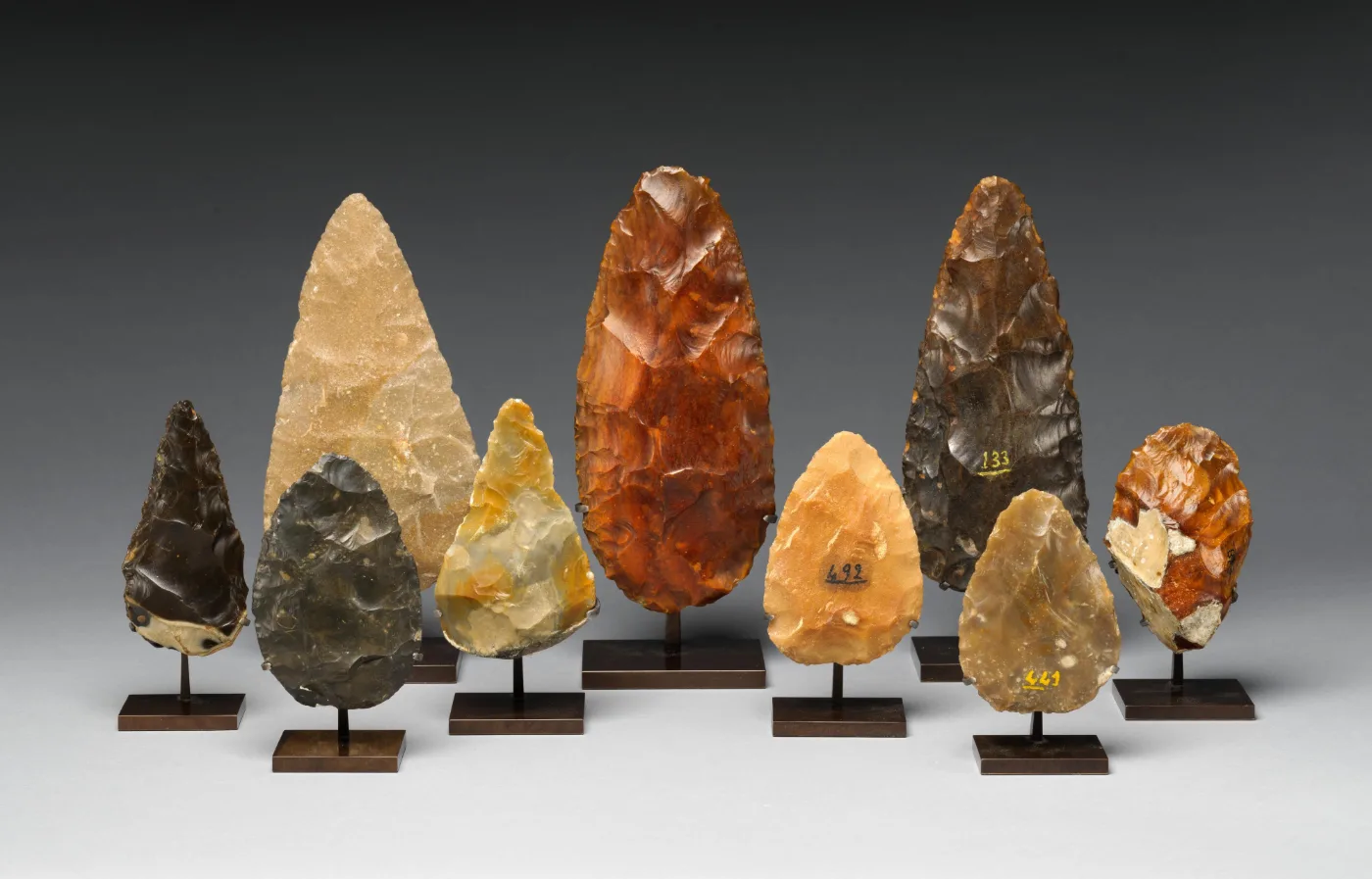
Prehistoric flaked stone hand axes in a museum collection
Era 1 · Prehistory
1. Prehistoric Technology: The First Human Tools
Around 3.3 Million Years Ago — Early Stone Tools
The earliest known stone tools date back approximately 3.3 million years.
These discoveries show that toolmaking began long before modern industrial machines and digital devices.
Early stone tools could be used for tasks such as cutting, breaking and processing materials.
Over time, toolmakers developed more sophisticated techniques and created increasingly specialized implements.
The Use of Fire
The use and controlled management of fire became another major development.
Fire provided warmth, protection and new methods of preparing food.
Evidence for the timing and extent of early fire control varies, so historians and archaeologists do not assign one universally accepted invention date.
These early developments established the foundation of technological problem-solving.
Era 2 · Ancient Civilizations
2. Agricultural and Ancient Technology: The Rise of Civilizations
Around 10,000 BCE — Agriculture Expands
The development of agriculture occurred gradually in several regions of the world.
Farming introduced new tools and techniques for cultivating plants, managing animals and storing food.
As agricultural communities expanded, technologies such as irrigation, pottery and construction methods became increasingly important.
Fourth Millennium BCE — Wheels and Writing
Early evidence of wheeled transportation dates to the fourth millennium BCE.
Wheels made certain forms of land transportation and mechanical work easier.
Writing systems also developed in ancient civilizations, including Mesopotamia.
They enabled people to record transactions, laws, administrative information and cultural knowledge.
Ancient Engineering
Civilizations developed increasingly sophisticated technologies for construction, water management, mathematics, metallurgy and navigation.
Examples include irrigation systems, roads, ships, mechanical devices and architectural structures.
Technological progress was not limited to one civilization. People across Africa, Asia, Europe and the Americas contributed important ideas over many centuries.
Era 3 · Medieval and Early Modern
3. Printing and Mechanical Innovation: Sharing Knowledge
11th Century — Movable-Type Printing in China
Movable-type printing was developed in China during the 11th century, traditionally associated with Bi Sheng.
Printing technology had already existed in other forms, including woodblock printing.
Movable type introduced another way to reproduce written materials using reusable characters.
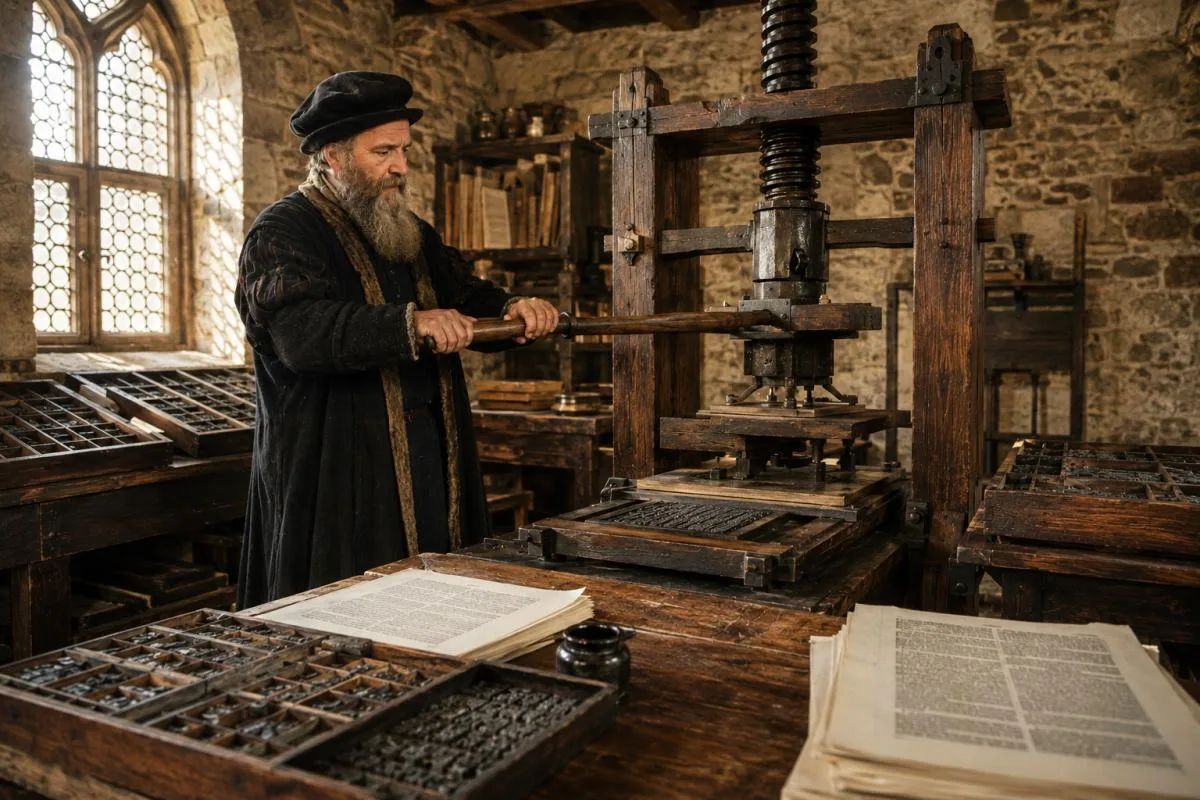
Around 1450 — Gutenberg’s Printing System
Johannes Gutenberg developed an influential movable-metal-type printing system in Europe during the mid-15th century.
Its combination of movable type, ink, press technology and production methods helped expand the manufacture of books.
As printed materials became more widely available, the exchange of scientific, religious and educational ideas accelerated.
Printing technology played an important role in the history of communication and knowledge sharing.
Mechanical Clocks and Other Inventions
Improved mechanical clocks, navigational instruments and manufacturing techniques also contributed to technological development.
These inventions supported more precise measurement, travel, trade and scientific investigation.
Illustrative reconstruction of a 15th-century style printing workshop (not a historical photograph)
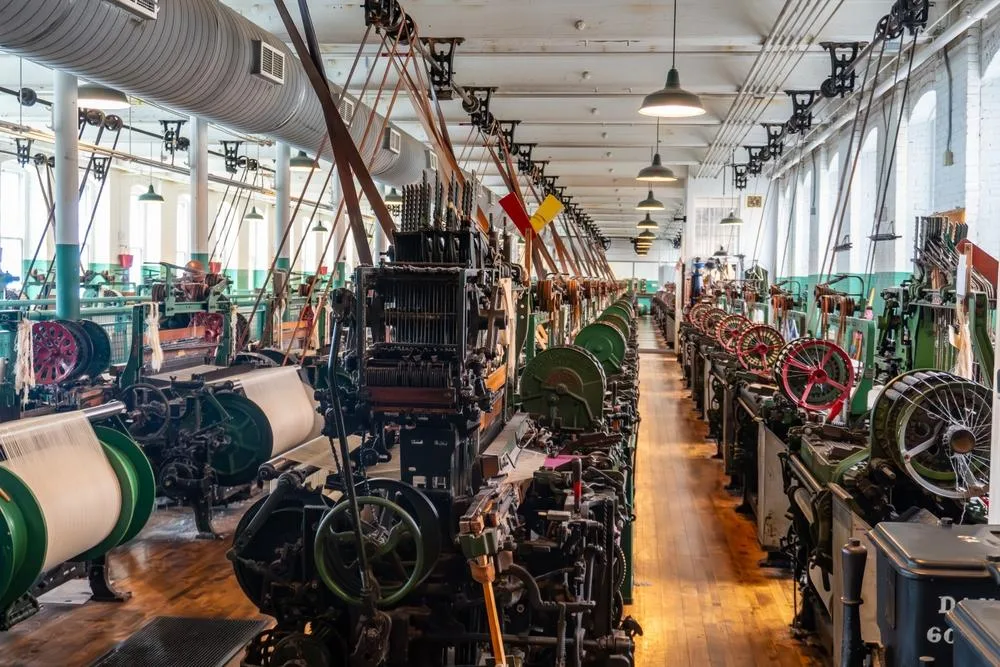
Historic power looms preserved in a textile mill
Era 4 · 18th and 19th Centuries
4. Industrial Revolution: Machines Transform Society
18th Century — Steam Power Develops
During the Industrial Revolution, improved steam engines became increasingly useful for manufacturing, mining and transportation.
James Watt’s developments during the second half of the 18th century helped make steam-engine technology more efficient and practical for a wider range of applications.
Steam-powered machinery supported industrial production and encouraged changes in factories and transportation networks.
19th Century — Railway Transportation
Steam locomotives transformed the movement of goods and passengers.
Richard Trevithick demonstrated a successful steam locomotive hauling a load in 1804.
The opening of major public steam railways during the 1820s and 1830s helped establish rail transportation as an important part of industrial society.
1830s and 1840s — Electrical Telegraph
Electrical telegraph systems made it possible to transmit messages over long distances much faster than physical transportation.
Researchers and inventors developed different telegraph technologies in several countries.
Telegraph networks transformed business, government communication, journalism and transportation coordination.
Era 5 · Electricity
5. Electricity and Modern Communication
1876
The Telephone
Alexander Graham Bell received an important telephone patent in 1876.
Telephone technology developed through the contributions of several researchers and inventors.
It eventually allowed people to communicate directly through voice across increasing distances.
Over subsequent decades, telephone networks became essential communication infrastructure.
Late 1870s
Electric Lighting
Inventors developed practical electric-lighting systems during the late 19th century.
Thomas Edison’s incandescent lamp developments in 1879 were a major milestone, alongside work by Joseph Swan and others.
Electric lighting changed homes, workplaces and public spaces.
Late 19th and Early 20th Centuries
Radio
Radio technology developed through research into electromagnetic waves and wireless transmission.
Scientists and engineers helped transform experimental wireless communication into practical services.
Radio broadcasting later became a major source of news, information and entertainment.
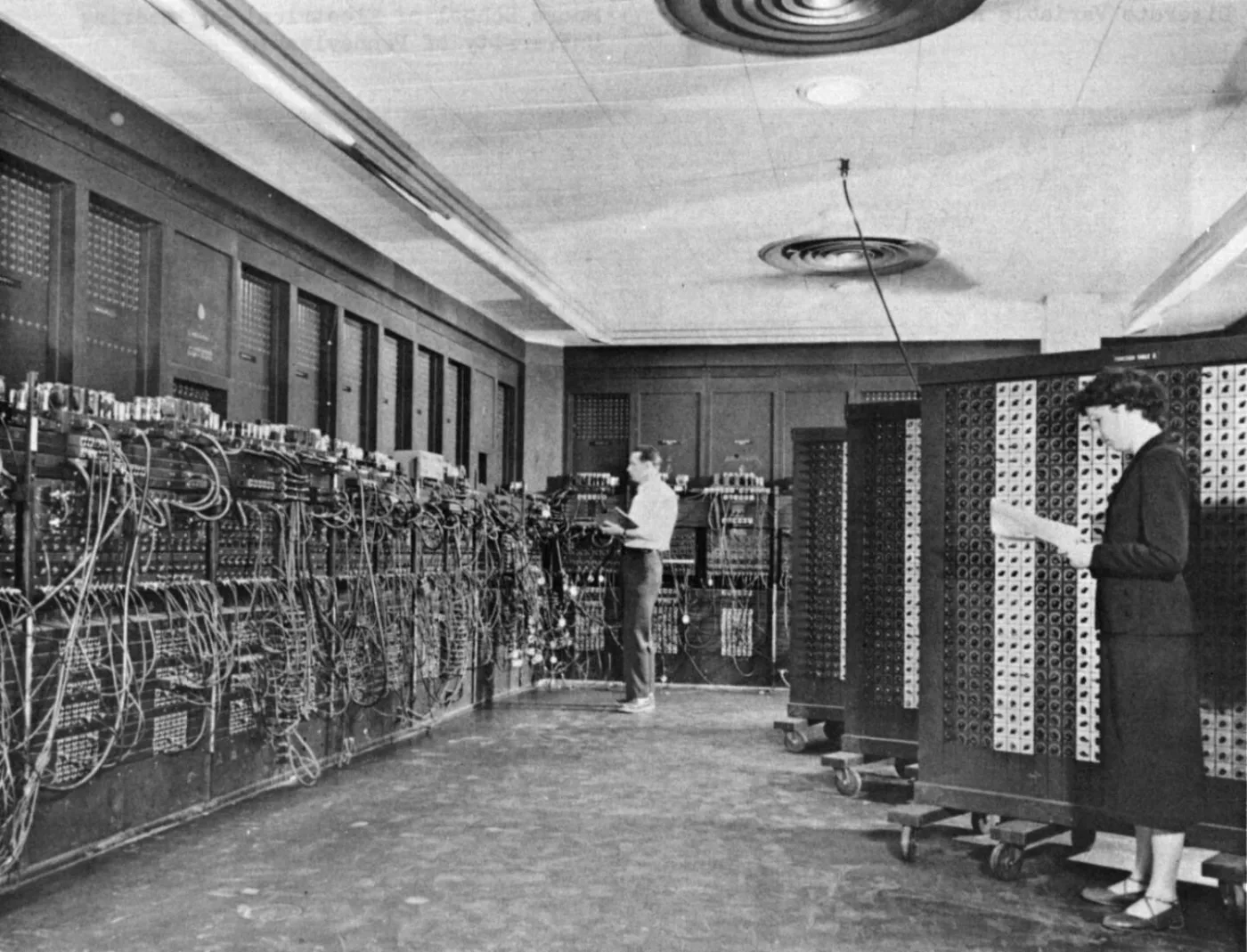
Historical photograph: ENIAC, an early general-purpose electronic computer, 1940s
Era 6 · Electronics
6. Electronic Technology: Television and Computers
Early 20th Century — Television Develops
Television emerged through decades of experimentation with mechanical and electronic image transmission.
Early demonstrations in the 1920s and developments in electronic television during the 1930s helped establish modern broadcasting.
Television changed how people received news, watched entertainment and experienced major public events.
1940s — Electronic Computers
The first generations of electronic computers were large, expensive machines designed for specialized calculations and research.
Developments such as ENIAC demonstrated the potential of electronic digital computation.
Early computers used large numbers of electronic components and required substantial space and electrical power.
1947 — The Transistor
The invention of the point-contact transistor at Bell Laboratories in 1947 was a major breakthrough.
Transistors enabled electronic switching and amplification using semiconductor materials.
They eventually helped reduce the size and power requirements of many electronic devices.
1958–1959 — Integrated Circuits
Jack Kilby and Robert Noyce made important contributions to early integrated-circuit technology.
Integrated circuits made it possible to combine multiple electronic components in increasingly compact designs.
This development helped create the foundation for modern microelectronics.
Era 7 · Digital Revolution
7. The Digital Revolution: Microprocessors and Personal Computers
1971 — The Microprocessor
Intel introduced the 4004 microprocessor in 1971.
The chip brought central processing functions together in a compact integrated circuit.
Microprocessors became important components in calculators, computers and many later electronic devices.
1970s–1980s — Personal Computing
Personal computers gradually became more available to individuals, schools and businesses.
Products such as the Apple II and IBM Personal Computer helped expand interest in computing.
As software developed, computers became useful for writing, calculations, design, education and business operations.
Digital Cameras and Other Electronics
Advances in electronic sensors, digital storage and processing helped transform photography.
Digital cameras gradually became practical alternatives to film cameras.
The same broader developments in semiconductors and computing influenced televisions, watches, communication systems and other devices.
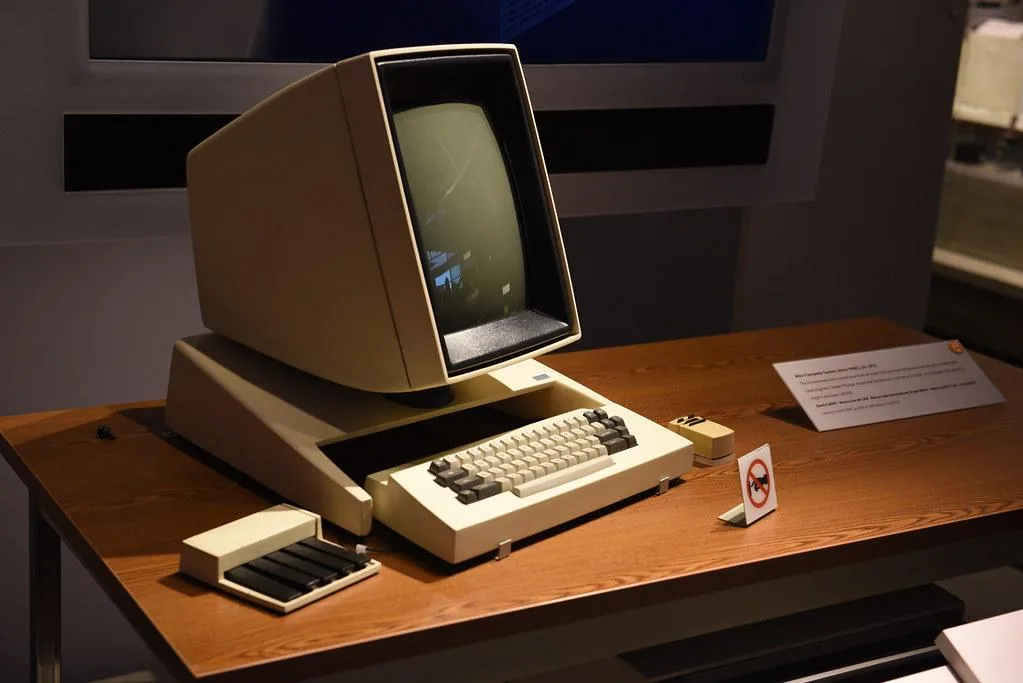
Xerox Alto computer on display in a computer history museum
Era 8 · Networks
8. The Internet and World Wide Web
1969
ARPANET
ARPANET began operating in 1969 as an early packet-switched computer network.
Its development contributed to research into interconnected computing systems.
Networking technologies continued to evolve through the 1970s and 1980s.
1983
TCP/IP Transition
ARPANET’s adoption of TCP/IP protocols on 1 January 1983 became a landmark in the development of modern internetworking.
These protocols helped different computer networks communicate using shared standards.
1989
The World Wide Web
Tim Berners-Lee proposed the World Wide Web while working at CERN in 1989.
The Web introduced a system of linked documents accessible through networked computers.
In 1993, CERN made the Web’s software freely available, helping accelerate its wider adoption.
Internet vs. World Wide Web
The internet and World Wide Web are related but not identical: the internet is the underlying network infrastructure, while the Web is one of the services built on it.
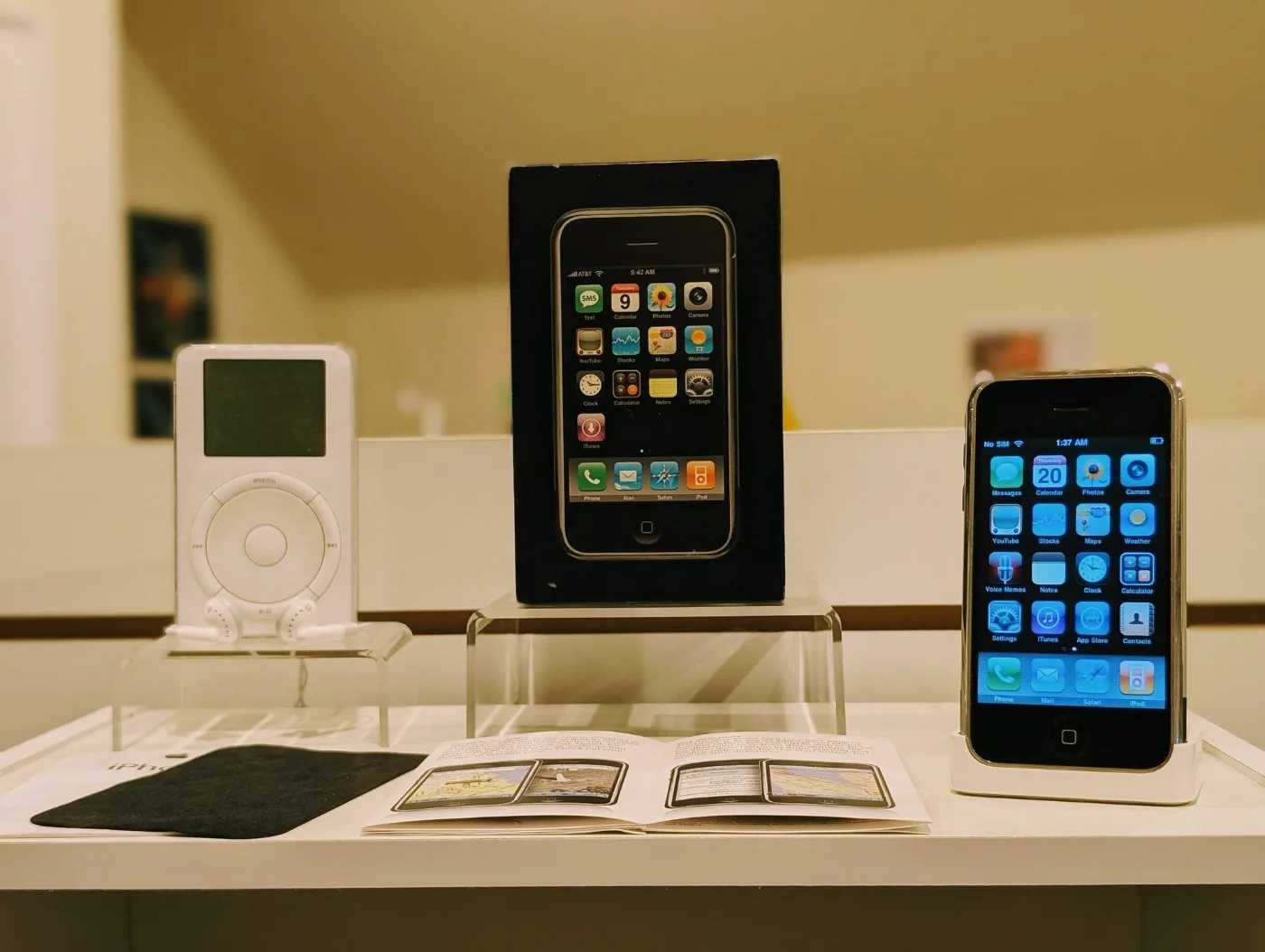
The original iPhone (2007) and its box beside an early iPod on museum display
Era 9 · Connected World
9. Smartphones and the Connected Digital World
1990s–2000s — Mobile Communication Develops
Mobile telephones became smaller and more accessible as cellular networks expanded.
Some mobile devices introduced digital messaging, basic internet access, cameras and personal information management.
The development of increasingly capable mobile processors, batteries and displays allowed more functions to fit into portable devices.
2007 — The iPhone
Apple introduced the first iPhone in 2007.
Its touchscreen interface and integration of communication, media and computing contributed to major changes in smartphone design and use.
Smartphone development also involved innovations from many other manufacturers and mobile platforms.
2010s — Mobile Apps and Cloud Services
Mobile applications, faster wireless networks and cloud computing transformed daily digital experiences.
People increasingly used mobile devices for communication, photography, navigation, education, banking and entertainment.
Social media platforms expanded the ability to publish and share information across the world.
Era 10 · Intelligent Machines
10. Artificial Intelligence and Robotics
Early AI Research
Artificial intelligence developed as a recognized research field during the 1950s, drawing on earlier work in mathematics, computing and logic.
Researchers explored ways to make computer systems perform tasks involving reasoning, search, language and pattern recognition.
Industrial Robotics
Industrial robots became increasingly useful in manufacturing during the second half of the 20th century.
Robotic systems helped automate repetitive tasks in industries such as automotive manufacturing and electronics.
2010s — Deep Learning Advances
Improvements in computing hardware, data availability and machine-learning techniques supported major advances in image recognition, speech processing and other applications.
These developments accelerated interest in artificial intelligence across research and industry.
2020s — Generative Artificial Intelligence
Generative AI systems became widely used for producing and transforming text, images, software and other forms of content.
These systems created new possibilities for learning, communication, scientific research and workplace assistance.
However, they also introduced important questions involving accuracy, privacy, copyright, bias, energy consumption and responsible deployment.
AI and robotics continue to develop, but their future impact depends on both technical progress and human decisions.
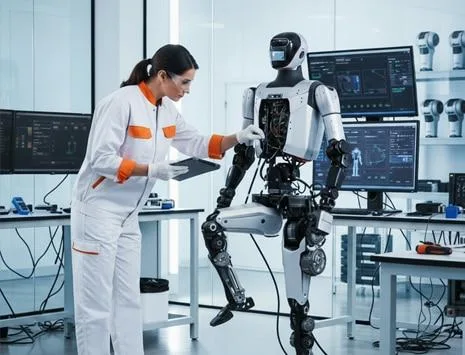
A humanoid robot being adjusted in a modern robotics laboratory
Compare the Eras
How Technology Has Changed Over Time
Historical period
Major technologies
Main changes
Prehistoric
Stone tools and fire
Early problem-solving and material processing
Ancient
Agriculture, wheels and writing
Settlements, trade and recordkeeping
Medieval and early modern
Printing and mechanical systems
Wider knowledge reproduction and improved measurement
Industrial
Steam engines, railways and factories
Mechanized production and transport
Electrical and electronic
Telephones, radio, lighting and television
Faster communication and new forms of daily life
Digital
Microprocessors, computers and networking
Information processing and connectivity
Modern connected era
Smartphones, cloud computing, AI and robotics
Portable computing, automation and intelligent services
Impact
Why the Evolution of Technology Matters
Technological development has influenced nearly every part of society.
Knowledge
Printing and communication technologies helped information travel farther and faster.
Industry
Electricity, electronics and computers reshaped manufacturing, education, medicine and entertainment.
Communication
Digital systems now connect people across the world and support work that once required much larger organizations and specialized equipment.
Social Change
Agricultural inventions changed food production and settlement patterns. Transportation innovations supported trade and travel.
Challenges
However, technological progress can create new challenges involving inequality, privacy, environmental impacts and economic disruption.
Understanding the history of technology helps us evaluate both the benefits and consequences of innovation.
What Comes Next
The Future of Technology
Future technological development may involve more advanced artificial intelligence, robotics, energy systems, computing hardware and communications infrastructure.
Researchers are working on more efficient semiconductor designs, improved batteries, quantum technologies and systems that help people use information more effectively.
Some developments may become widely adopted, while others will remain experimental or prove unsuitable for large-scale use.
The future will depend not only on what engineers can build, but also on whether new technologies are safe, accessible, useful and socially responsible.
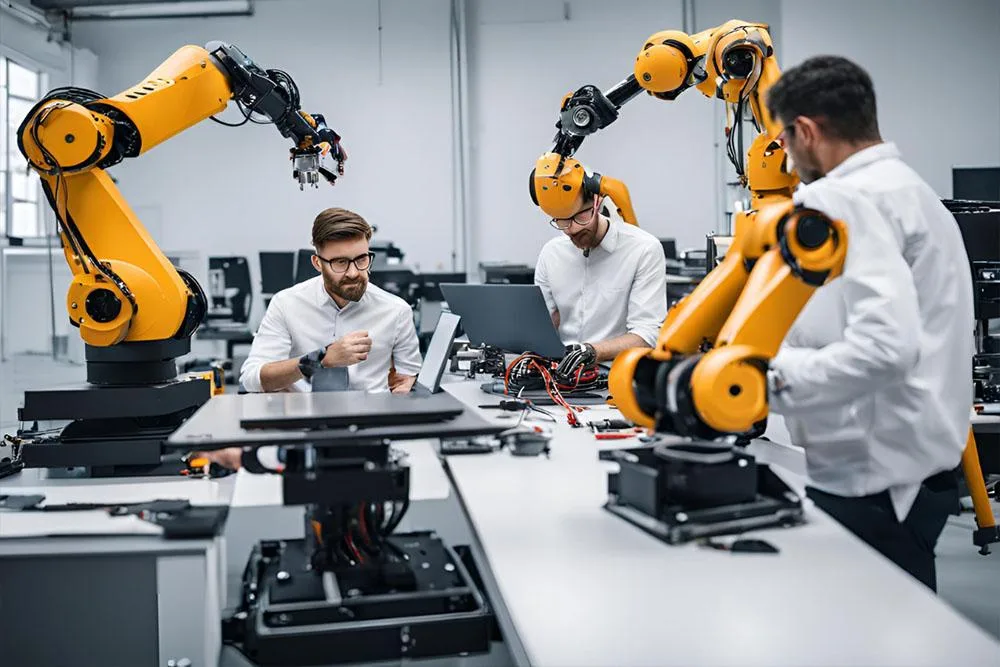
Engineers working with industrial robot arms in a modern robotics lab
It is a chronological explanation of major technological inventions and developments, showing how tools and systems changed from early human history to the modern digital age.
There is no single universally accepted answer. Important transformations include agriculture, writing, printing, steam power, electricity, transistors, computers and the internet.
Computers developed through several stages. Early mechanical calculating devices preceded the large electronic digital computers developed during the 1940s.
The modern internet emerged through decades of networking research. ARPANET began in 1969, and the transition to TCP/IP in 1983 was an important milestone.
Tim Berners-Lee proposed the World Wide Web at CERN in 1989. Its public availability expanded significantly after CERN released the Web software in 1993.
Artificial intelligence, robotics, advanced computing, renewable energy, battery technology and improved communications systems are among the areas likely to influence future development.
Keep Exploring
Explore Related Technology Timelines
Continue exploring the history of individual technologies through our dedicated guides:
Phones
Learn how telephones evolved into modern smartphones.
Timeline coming soon
iPhone
Explore the changes across iPhone generations.
Timeline coming soon
Computers
Discover the history of computing and microprocessors.
Timeline coming soon
Internet & Web
Follow the development of global computer networks and the World Wide Web.
Timeline coming soon
Social Media
Explore how online communities and social platforms evolved.
Timeline coming soon
Artificial Intelligence & Robots
Discover major developments in machine intelligence and robotics.
Timeline coming soon
Television
Explore broadcasting and the evolution of television technology.
Timeline coming soon
Cameras
Learn about the development of photography and digital cameras.
Timeline coming soon
Watches
Follow timekeeping technology from mechanical watches to smartwatches.
The evolution of technology demonstrates how human creativity, scientific discovery and practical needs have shaped the world.
From early stone tools to computers, global networks and artificial intelligence, each generation has built upon knowledge developed by earlier societies.
The history of technology is not simply a record of inventions. It is a story of how people use new ideas to transform everyday life—and how those changes create opportunities and challenges for the future.
Explore our related timelines to learn more about the inventions, discoveries and technologies behind this ongoing journey.