Evolution of Trains Timeline: From Steam Locomotives to High-Speed Rail
From the first steam locomotive in 1804 to modern bullet trains and magnetic levitation, railway transportation has undergone more than two centuries of remarkable innovation.
This evolution of trains timeline explores the key inventions, historical milestones and engineering breakthroughs that transformed simple wagonways into some of the fastest land transportation systems in the world.
Discover when trains were invented, how steam locomotives revolutionized travel, why diesel and electric trains became important, and how high-speed rail changed the future of transportation.
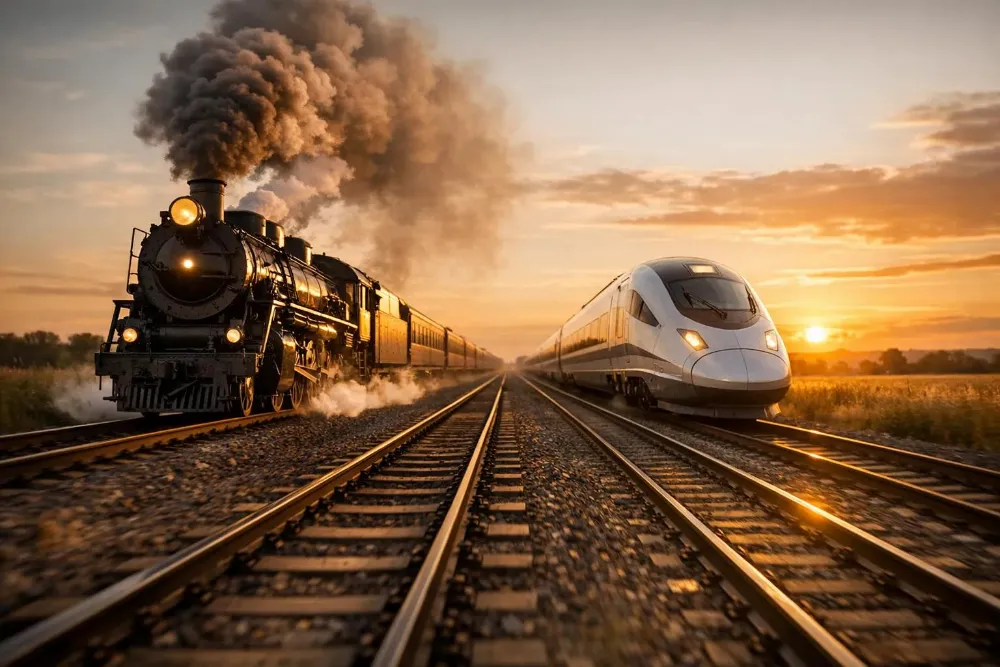
Evolution of Trains Timeline at a Glance
The history of modern trains began with early industrial railways and accelerated after Richard Trevithick demonstrated a working steam locomotive in 1804.
Here are the major milestones that shaped railway history.
First successful steam locomotive demonstration
Stockton and Darlington Railway
Liverpool and Manchester Railway
Japan's Shinkansen
Shanghai Maglev
L0 Maglev world speed record
Railway Milestones Reference Table
Wooden wagonways
Early guided transportation of heavy loads
Trevithick’s steam locomotive
Demonstrated steam-powered rail transport
Salamanca locomotive
Early commercially successful steam locomotive
Stockton and Darlington Railway
Major milestone in public steam railway transport
Stephenson’s Rocket
Influential advance in locomotive engineering
Liverpool and Manchester Railway
Pioneering steam-powered intercity railway
London Underground
World’s first underground railway
First US Transcontinental Railroad completed
Transformed long-distance rail connections
Diesel and electric traction expands
Reduced dependence on steam power
Japan’s Tōkaidō Shinkansen
Beginning of modern high-speed rail
France’s TGV enters service
Major expansion of high-speed rail in Europe
Shanghai Maglev opens commercially
Landmark in high-speed magnetic-levitation transport
Japanese L0 maglev reaches 603 km/h
World speed record for a maglev train
Before Steam Trains: The Earliest Railways (1500s–1800)
The story of trains began long before the invention of the steam engine.
During the 16th century, miners in parts of Europe used wooden rails to guide carts carrying coal and minerals. These early tracks, commonly called wagonways, allowed horses and workers to move heavier loads more efficiently than they could on uneven ground.
By the early 17th century, wagonways had appeared in England. The Wollaton Wagonway, built in 1604 near Nottingham, is among the earliest documented examples.
Over time, engineers introduced stronger rails, iron components and improved wheel designs. These innovations made guided transportation increasingly practical.
However, early railways still depended mainly on human or animal power.
The breakthrough came when engineers began combining railway tracks with steam-powered machinery.

1804: Richard Trevithick's First Steam Locomotive
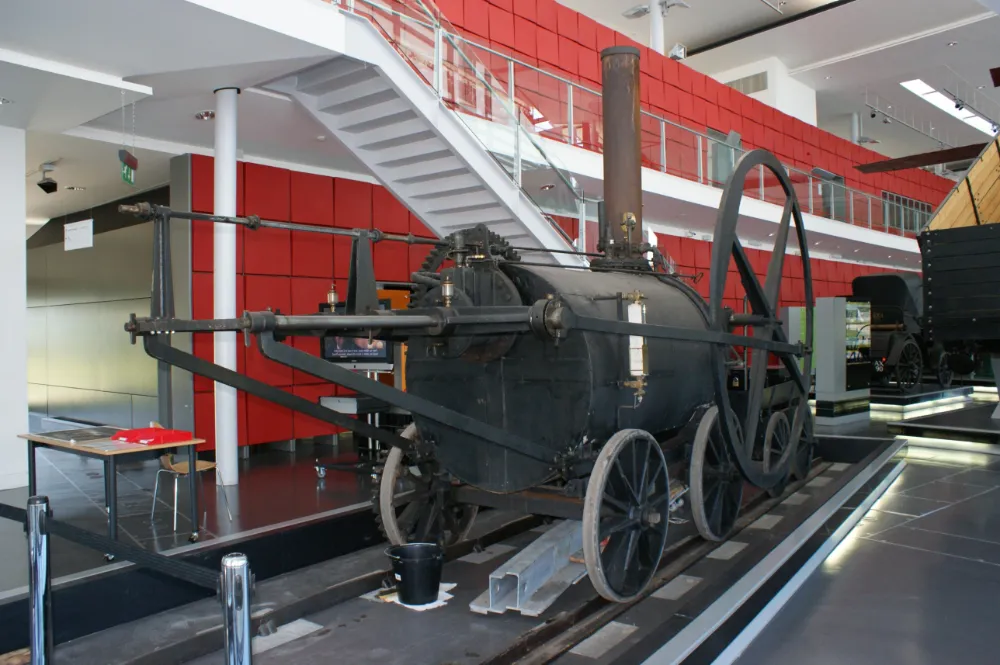
On 21 February 1804, British engineer Richard Trevithick demonstrated a steam-powered railway locomotive on the Penydarren Tramroad in South Wales.
During the historic demonstration, the locomotive hauled approximately 10 tons of iron and around 70 people over a journey of roughly nine miles.
This achievement was revolutionary because it demonstrated that a steam engine could pull heavy loads along a railway.
The locomotive was not a complete commercial success. Its weight placed considerable strain on the existing track, and early railway infrastructure was not designed for such heavy machinery.
Nevertheless, the Penydarren demonstration became a defining event in transportation history.
Why 1804 matters: It marks the first widely recognized successful demonstration of a full-scale steam locomotive hauling a load on rails.
1812–1830: The Birth of Commercial Railways
1812 — The Salamanca Locomotive
In 1812, the Salamanca, designed by Matthew Murray, began operating on the Middleton Railway near Leeds, England.
It used a rack-and-pinion mechanism to improve traction and became one of the earliest commercially successful steam locomotives.
Its operation demonstrated that steam-powered railways could support regular industrial transportation.
1825 — Stockton and Darlington Railway
On 27 September 1825, the Stockton and Darlington Railway officially opened in northeastern England.
George Stephenson’s Locomotion No. 1 hauled the opening train, carrying passengers and goods.
The railway became a landmark in the development of public steam transportation, demonstrating the economic and practical possibilities of locomotive-powered railways.
1829 — Stephenson's Rocket
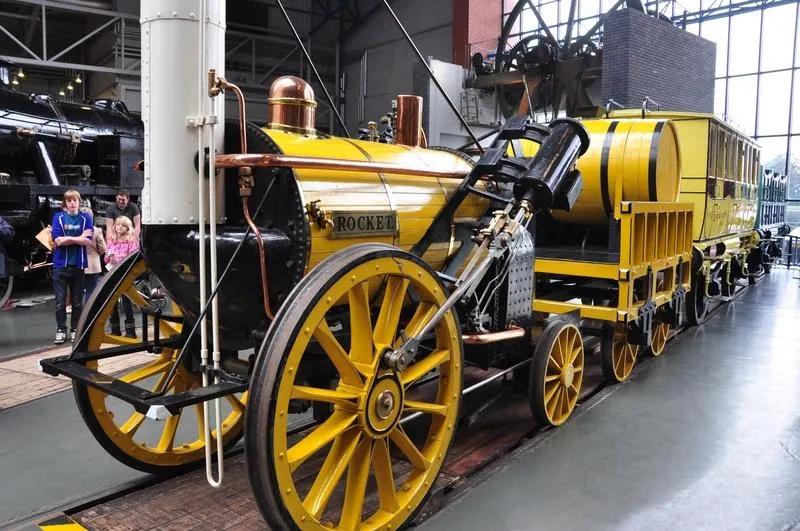
The famous Rocket, developed by George and Robert Stephenson, won the Rainhill Trials in 1829.
Its engineering features, including an effective boiler arrangement and improved steam circulation, influenced later locomotive designs.
The Rocket helped demonstrate the growing speed and reliability of railway technology.
1830 — Liverpool and Manchester Railway
The Liverpool and Manchester Railway opened in September 1830.
It was the first major steam-powered intercity railway designed to carry both passengers and freight.
This development helped establish rail travel as a practical alternative to traditional road and canal transportation.
Why this period matters: Between 1812 and 1830, steam locomotives developed from experimental machines into working transportation systems.
1830–1900: The Golden Age of Steam Trains
During the 19th century, railways expanded across Europe, North America and many other regions.
Railway networks connected industrial centers, ports, cities and agricultural areas. Goods could be transported in larger quantities, while passengers could travel distances that previously required lengthy journeys.
Several important milestones helped shape this expansion.
1863 — The First Underground Railway
London’s Metropolitan Railway opened in 1863, becoming the world’s first underground passenger railway.
Its early services used steam locomotives, long before electric underground trains became widespread.
1869 — The US Transcontinental Railroad
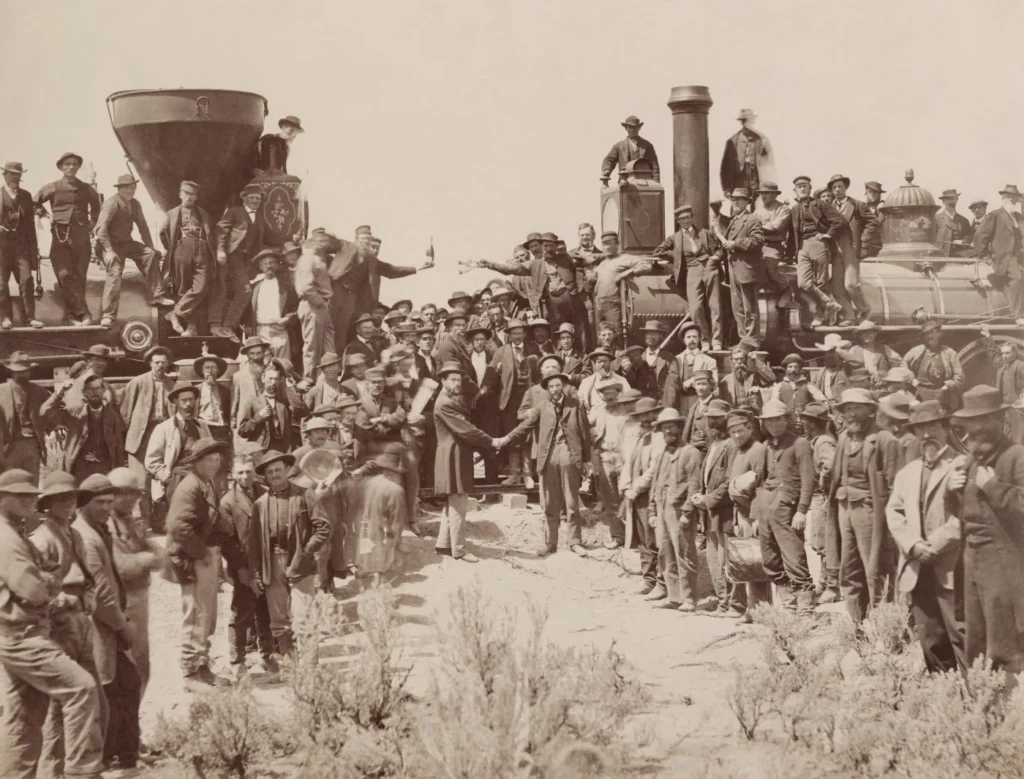
In May 1869, the first transcontinental railroad was completed at Promontory Summit, Utah.
The project linked major eastern rail networks to the Pacific coast through a continuous rail connection, dramatically improving cross-country transportation.
Late 1800s — Safer and More Comfortable Travel
Railway companies introduced technological and operational improvements such as air brakes, better couplers, improved signaling and more comfortable passenger carriages.
Sleeping cars and dining cars made long-distance railway journeys more convenient.
By the end of the century, railways had become an essential part of industrial development, trade and travel.
1900–1950: From Steam to Diesel and Electric Trains
Although steam locomotives remained important during the early 20th century, alternative forms of railway propulsion were developing.
Electric Trains
Electric railway systems used power supplied through overhead wires, third rails or other electrical infrastructure.
Electric traction offered important advantages, including strong acceleration and the absence of exhaust emissions at the train itself.
Early electrical systems were especially valuable for urban railways, underground transportation and busy passenger routes.
Diesel Trains
Diesel-powered locomotives became increasingly important during the 20th century.
Diesel-electric designs used an onboard diesel engine to generate electricity for traction motors.
Compared with many steam locomotives, diesel locomotives generally required less routine servicing and could operate without the extensive water and coaling infrastructure associated with steam.
Streamlined Trains
During the 1930s, streamlined train designs demonstrated new possibilities for speed, efficiency and passenger comfort.
Examples included America’s Pioneer Zephyr and Germany’s Flying Hamburger.
These developments helped prepare the railway industry for the next major transformation: high-speed passenger trains.

1950–1964: Modernization of Railway Transportation
After the Second World War, numerous railway systems began replacing steam locomotives with diesel and electric technology.
Railway operators focused increasingly on operating costs, reliability, passenger experience and higher speeds.
Better braking systems, signaling, track construction and electric traction also made faster railway services more practical.
As air and road transportation expanded, railways faced new competition. Faster and more efficient passenger services became an important response.
Japan would soon introduce a development that fundamentally changed expectations about train travel.
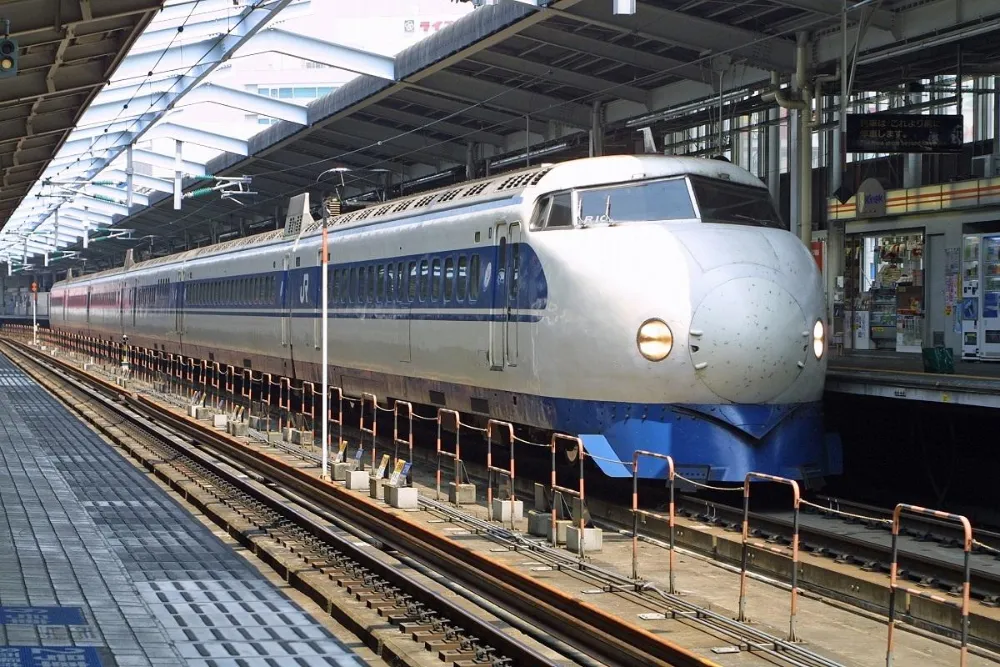
1964: Japan Introduces the Shinkansen Bullet Train
On 1 October 1964, Japan opened the Tōkaidō Shinkansen between Tokyo and Osaka.
The railway was designed specifically for high-speed passenger transportation and became the foundation of Japan’s modern bullet-train network.
The original Shinkansen operated with a maximum service speed of 210 km/h, representing a major breakthrough in regular passenger railway operations.
Its success demonstrated the advantages of dedicated high-speed infrastructure, advanced signaling, electric traction and carefully coordinated operations.
The Shinkansen also showed that railways could remain competitive over important intercity routes despite the growth of automobiles and aviation.
Why 1964 matters: The opening of the Tōkaidō Shinkansen is widely recognized as the beginning of the modern high-speed railway era.
1981–2000: High-Speed Rail Expands Internationally
Following Japan’s success, other countries developed dedicated high-speed railway systems.
France Introduces the TGV
France launched its first TGV high-speed service in 1981.
The system connected major cities using advanced electric trains and purpose-built high-speed infrastructure.
It became an influential model for the development of high-speed rail in Europe.
High-Speed Technology Spreads
Over subsequent decades, countries including Germany, Spain and others developed or expanded faster passenger railway networks.
Advances in aerodynamic design, suspension, train control systems and railway infrastructure helped improve speed and passenger comfort.
High-speed railway development increasingly focused on balancing performance with safety, operating costs and network capacity.
2004: Shanghai Maglev and Magnetic Levitation
Magnetic-levitation trains introduced a different method of railway transportation.
Instead of relying on conventional wheels rolling along rails, maglev systems use magnetic forces to support and guide the vehicle.
This can reduce mechanical contact and enable extremely high speeds.
Shanghai’s commercial maglev service began operating in 2004, connecting Pudong International Airport with Longyang Road.
The system historically operated at speeds reaching approximately 431 km/h. Its more recent regular service speed has been lower.
Maglev technology demonstrated the potential of magnetic suspension, although the cost of specialized infrastructure remains a major obstacle to wider adoption.
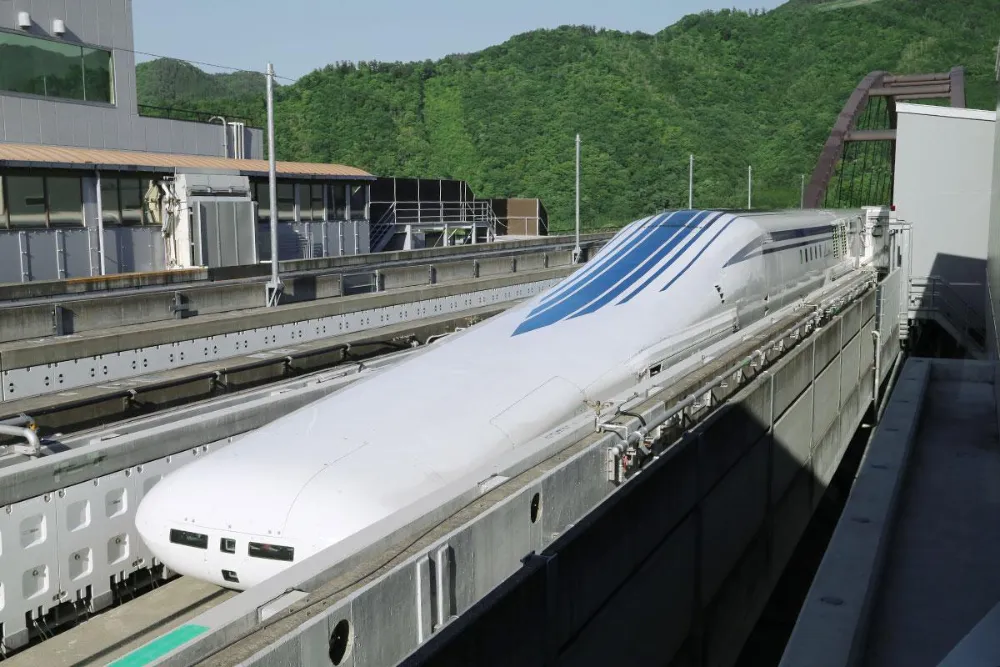
2015: Japan's L0 Maglev Reaches 603 km/h
On 21 April 2015, a Japanese L0 Series maglev train operated by Central Japan Railway Company achieved a test speed of 603 km/h on the Yamanashi Maglev Line.
This established a major world speed record for magnetic-levitation trains.
The achievement demonstrated the remarkable performance possible with advanced maglev technology.
However, test speeds should not be confused with everyday passenger operating speeds. Commercial rail systems must balance speed with safety, energy consumption, infrastructure requirements and operating costs.
2020s: Modern Trains and the Future of Rail Travel
Modern railway technology continues to develop in several directions.
High-speed electric trains connect major cities in different parts of the world. Digital signaling systems help railway operators manage increasingly complex networks.
Researchers and manufacturers are also exploring energy storage, battery-powered trains, hydrogen fuel-cell trains, advanced automation and improved infrastructure efficiency.
These developments aim to reduce dependence on fossil fuels, improve reliability and support transportation needs.
Maglev technology may also play a greater role in future long-distance transportation, although major projects require substantial investment and technical development.
Experimental concepts such as low-pressure tube transportation remain separate from established commercial railway systems.
The next chapter in train evolution may be defined not simply by higher speeds, but by improved accessibility, energy efficiency, safety and integration with other transportation networks.
How Have Trains Changed Over Time?
Modern trains benefit from more than two centuries of improvements in propulsion, track design, materials, braking, signaling and operations.
Power
Coal-fired steam engines
Primarily electric traction
Speed
Generally relatively slow
Often 250–350 km/h on suitable systems
Passenger comfort
Basic early carriages
Climate control, improved seating and modern facilities
Signaling
Early manual and mechanical systems
Advanced electronic and automatic train control
Maintenance
Extensive mechanical servicing
Modern diagnostic and maintenance systems
Infrastructure
Early conventional rail tracks
Precision-built high-speed rail networks
For a detailed comparison of engines, speed, design and comfort across six railway eras, see our Evolution of Trains Over Time guide.
Why the Evolution of Trains Matters
The history of trains is about far more than engines and speed records.
Industry
Railways transformed industrial transportation by making it easier to move raw materials, manufactured goods and agricultural products over long distances. Railway engineering also inspired advances in manufacturing and infrastructure.
Global Trade
Railways also influenced international trade, and rail continues to play a significant role in freight movement today.
Urban Development
Railways influenced the growth of cities and commuting patterns, and railway timetables contributed to the standardization of time.
Passenger Transportation
Railways made long-distance passenger travel faster and more practical, and today rail continues to play a significant role in passenger transport.
Understanding this history reveals how successive generations of inventors, engineers and railway workers helped shape the modern world.
Frequently Asked Questions
When was the first steam train invented?
Richard Trevithick demonstrated a successful steam-powered locomotive on the Penydarren Tramroad in Wales on 21 February 1804.
Who invented the first train?
There was no single inventor of every railway technology. Richard Trevithick pioneered successful steam locomotive operation in 1804, while engineers including George and Robert Stephenson helped develop practical commercial steam railways.
What was the first public steam railway?
The Stockton and Darlington Railway, opened in England in 1825, was a pioneering public steam-powered railway.
When were bullet trains invented?
Japan introduced the Tōkaidō Shinkansen in 1964, marking the beginning of modern high-speed passenger railway services.
What is the difference between a bullet train and a maglev train?
Conventional bullet trains use steel wheels running on rails, while maglev trains use magnetic forces to support and guide the vehicle.
What is the fastest recorded maglev train?
Japan’s L0 Series maglev achieved a test speed of 603 km/h in April 2015.
How did trains change the world?
Trains transformed freight movement, passenger travel, industrial development, urban growth and long-distance connections by making transportation faster and more efficient.
Explore More Train History
Continue exploring the evolution of railway transportation through these related articles:
Discover the historical development of Indian railways, from early passenger services to modern railway systems.
Compare the designs, technologies, speeds and features of trains from different historical periods.
Explore the history of trains through simple explanations, interesting facts and educational illustrations.
Explore the Main Evolution of Trains Hub
Discover additional railway history topics, technological developments and historical train articles.
Sources and Further Reading
Dates and facts in this timeline were checked against museum, government and record-keeping sources, including:
- Amgueddfa Cymru – Museum Wales: Richard Trevithick's steam locomotive
- Grace's Guide to British Industrial History: Fenton, Murray and Wood – Salamanca
- National Railway Museum: Shildon, the Cradle of the Railways and Locomotion No. 1
- Science Museum Group Collection: Stephenson's Rocket
- London Transport Museum: The world's first Underground
- U.S. National Park Service: Golden Spike National Historical Park
- Government of Japan (japan.go.jp): History of the Shinkansen (PDF)
- Shanghai Pudong New Area Government: Shanghai Maglev Train
- Guinness World Records: Fastest maglev train